One of the best researched, referenced, and written books about the USS Franklin (CV-13) is Saving Big Ben: The USS Franklin and Father Joseph O’Callahan by John R. Satterfield. This book has been a valuable source of information throughout the development of this documentary.
Because of John’s background as a retired naval reserve officer and his knowledge of the USS Franklin (CV-13), I’ve reached out to him several times for insight on specific aspects of the ship’s story. He has been exceptionally generous with his time and expertise, and his input has helped to shape the film. (My thanks and a warm shout-out to John if he’s reading this newsletter.)

Author: John R. Satterfield, Publisher: Naval Institute Press, Publication date: April 15, 2011
Print length: 288 pages, ISBN-10: 1591148081, ISBN-13: 978-1591148081
In his book, John skillfully interweaves a biography of Father Joseph T. O’Callahan with the story of the Franklin. In the Postscript on page 137, he wrote, “Father Joe’s example still serves those who struggle to balance institutional and individual expectations and values.” It was this example we hoped to capture when we filmed at the College of the Holy Cross in Worcester, Massachusetts, which was Father O’Callahan’s home, workplace, and spiritual center from the time of his discharge from active duty in the Navy until his death on March 18, 1964.
John’s book lets us know the path that Father O’Callahan took from the Franklin to Holy Cross. He was detached from the carrier June 14, 1945 and went to Washington D.C. to serve as the chaplain for the Navy’s Office of Public Information. (Coincidentally, the Office of Public Information of the U.S. Navy has impacted the making of this documentary several times, but those are stories for another time.) The following month, Father Joe was promoted to the rank of Commander. As the famous chaplain from the USS Franklin, he traveled the country on a demanding schedule, giving talks and press interviews during a war bonds tour.
Father O’Callahan was assigned to brief shore duty at the Naval Training Center Newport and was then sent to the Brooklyn Navy Yard for the October 27, 1945 commissioning of the aircraft carrier USS Franklin D. Roosevelt (CVB-42), a Midway-class ship on which he would serve as chaplain.

| On January 23, 1946, Father O’Callahan and Lieutenant Donald Gary, along with two other servicemen, traveled to Washington, D.C. to receive the Medal of Honor from President Harry Truman. In February, Father Joe rejoined the Roosevelt and sailed on her shakedown cruise to Cuba and Brazil. After returning stateside and with his discharge imminent, he spent a short period in Washington D.C. assigned to the Navy’s Office of Public Relations, where he worked on the Education Program. |

| Just before he was to be released in June of 1946, Father O’Callahan received a last-minute assignment as chaplain escort for the repatriation of the body of former Philippine president Manuel Quezon, whose remains were transported aboard the Ticonderoga-class carrier USS Princeton (CV-37). In late August, for his official discharge from active duty, he flew from Manila to Cairo and then Rome, eventually returning to Boston by September 1. He was transferred from active duty to inactive Naval Reserve on November 12, 1946, and was retired in October 1953 with the rank of Captain. Father Joe wanted to do missionary work in Japan after release from active naval duty, but the mental and physical toll of his ordeal on the Franklin, and possibly the grueling war bonds tour, did not allow it. He returned to the College of the Holy Cross to teach in the Religion and Philosophy departments, and he lived in the Jesuit residence on campus. He suffered a stroke in December 1949 and never fully recovered; by 1951 he was no longer able to teach. He did, however, make a point of regularly visiting his nephew, Jay, who had begun his freshman year at Holy Cross. If you received Update #27, or if you visit the project website here, you can read about our interview with Jay O’Callahan and his memories of his uncle, Father Joe. We went to Holy Cross to document Father O’Callahan’s legacy, starting in the O’Callahan Science Library with an interview of Lisa Villa, Public Services and Engagement Archivist with the college’s Archives and Distinctive Collections. The interview was facilitated by Science Librarian Laura Wilson, who graciously delayed the library’s 8:00 a.m. opening to accommodate our filming. Lisa noted that the Science Library was named in Father O’Callahan’s honor because his substantial collection of mathematics and physics books, acquired during his years teaching those subjects before the war, formed the initial core of the library’s holdings. In this way, the college’s O’Callahan Science Library stands as a direct reflection of Father Joe’s academic legacy. |

After filming in the O’Callahan Science Library, we made the short walk with Lisa leading the way to Dinand Library and set up for interviews in the Reading Room of the Archives and Distinctive Collections. It is here where Father O’Callahan’s Medal of Honor and papers are preserved under archival conditions.
We continued our interview with Lisa, who reflected on Father O’Callahan’s enduring influence on the college. “We see him as a war hero, but academically, he also had some heroic measures,” she observed. She showed us one of the physics textbooks he assigned during his pre-war teaching years, and then a first-printing copy of his memoir, I Was Chaplain on the USS Franklin. Father O’Callahan had signed the book and given it to a friend, who later donated it to the Archives and Distinctive Collections, where it remains preserved today.


After finishing our interview with Lisa, we repositioned the lighting, sound, and camera equipment to the center of the room to film an interview with Sarah Campbell, Archivist with the college’s Archives and Distinctive Collections.
If you saw Production Update #28, you might recall that we also filmed with Sarah in the Holy Cross Jesuit cemetery, where Father O’Callahan is buried. I was remiss in that update for not thanking Father Andrew Garavel, Superior of the Jesuit Community at Holy Cross, for giving us permission to film in the cemetery.
Back in the Archives and with cameras rolling, Sarah brought out the boxes of Father O’Callahan’s archive. She walked us through several of the most compelling pieces from the collection, including his Medal of Honor and a handwritten letter from President Harry Truman, sent to Father Joe after the president learned he had fallen seriously ill. Sarah’s explanations and professional insights into these pieces were especially interesting.
I had seen these items before during an earlier visit to Holy Cross when I researched the Father O’Callahan archive for the film, which I described in Update #9 on the project website here. At the time, I hadn’t looked at the back of his Medal of Honor, so this time I made a point of it. To my surprise, the first sentence of the medal citation was engraved there in small, perfectly cut lettering.


While we were in the Reading Room of the Archives and Distinctive Collections, we were happily introduced to Holy Cross’ unofficial mascot, Purple Phil Crumpets. Named by the students in a contest, the doll was donated to the Archives by Father Philip Boroughs when he was concluding his tenure as president of the college in 2021. He had previously received Purple Phil as a gift from an alum. The antique doll wears the school colors, royal purple and white, and a giant version of him greets visitors as they enter the Reading Room. We asked Purple Phil for an interview, but he was too camera shy to oblige.

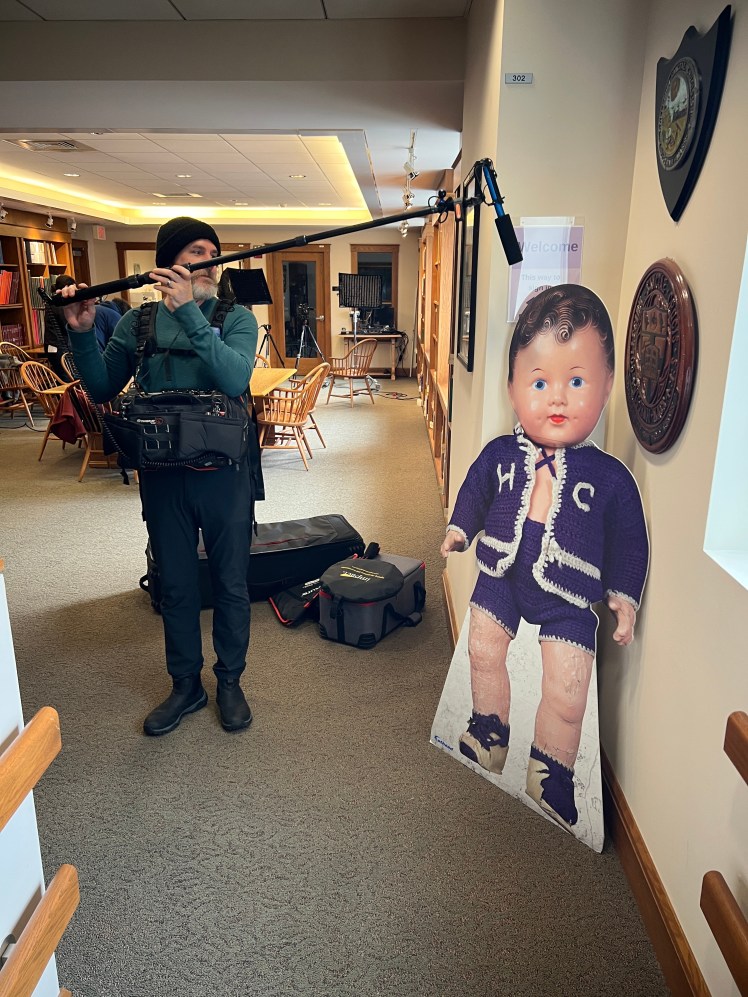
When we concluded the interviews in the Archives Reading Room, we broke for lunch and joined Lisa in the large, bustling student dining hall. After she got us in the door, we found plenty of options to choose from, and the food was really good.
Afterward, we returned to Dinand Library, loaded up the equipment, and drove across campus to Carlin Hall, home to the offices and spaces of the college’s Navy Reserve Officer Training Corps (NROTC). I extend my thanks to Holy Cross NROTC Commanding Officer Captain Bryan Pinckney, Executive Officer Captain Robin Marling, and Cynthia Hayes, Academic Administrative Assistant, for meeting with me and for reserving space for us in the O’Callahan Wardroom—a fitting location for our interview for the documentary.
Just as the O’Callahan Science Library was named to recognize Father O’Callahan’s academic contributions to the college, the O’Callahan Wardroom was named to honor his military service and achievements. You can see a film of the 1997 dedication of the O’Callahan Wardroom here.
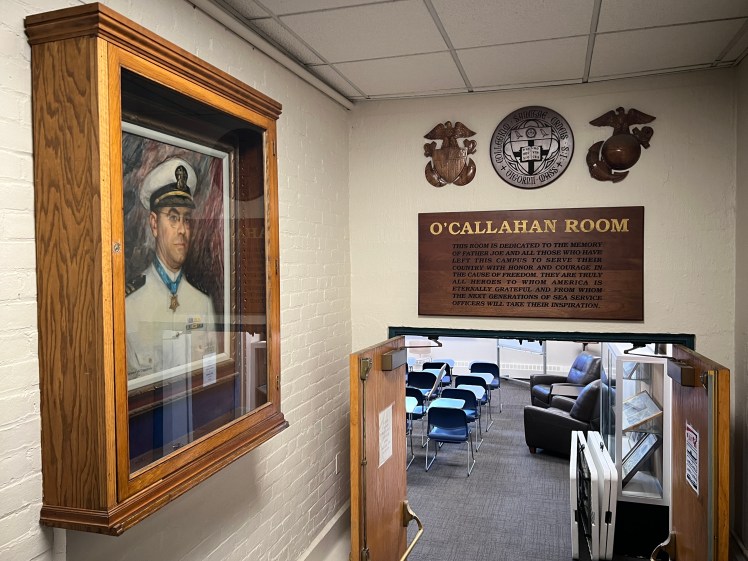

The inscription over the entry to the O’Callahan Wardroom reads, “This room is dedicated to the memory of Father Joe and all those who have left this campus to serve their country with honor and courage in the cause of freedom. They are truly all heroes to whom America is eternally grateful and from whom the next generations of sea service officers will take their inspiration.”
We were there to interview Peter von Loesecke, an alumnus of Holy Cross and its NROTC program, a retired Navy officer, and Chair of the O’Callahan Society. Peter told us that the Society was formed in the early 1990s when Father John Brooks, the president of the college at the time, asked a number of graduates of the college and its NROTC program to create a group to support the NROTC battalion at the college.
Honoring his request, the alumni formed the Joseph T. O’Callahan NROTC Scholarship Fund Committee in 1994 that supported the midshipmen on the campus. That group evolved and in 2009 became the O’Callahan Society that exists today. Peter told us, “Today the O’Callahan Society supports the midshipmen through two funds: The ‘Activities Fund’ which supports midshipmen intra-collegiate competitions and on-campus academic needs, and a newly formed ‘Brooks/O’Callahan Fund’ which provides financial assistance to selected non-scholarship Midshipmen called ‘College Programmers.’ The Activities Fund is the original fund supporting the battalion at Holy Cross.”
As described in the 2025 society newsletter, “The O’Callahan Society is an affinity group under the auspices of the Holy Cross Alumni Association. It continues the memory of Holy Cross professor, Rev Joseph T. O’Callahan, S.J., the first Navy chaplain to receive the Medal of Honor.” Stated on the Holy Cross website, “The O’Callahan Society encourages and cultivates the traditions associated with the Jesuit, liberal arts education of military and naval officers.”

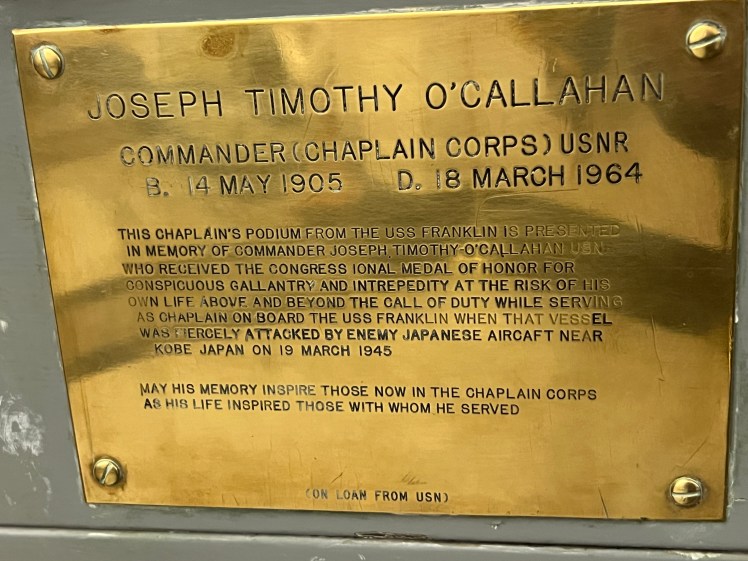
Prior to the interview, while we were still setting up in the wardroom, two strapping midshipmen brought in the O’Callahan podium from its usual place upstairs, just outside the main NROTC office. Battleship grey in color, the podium is affixed with the chaplain’s white cross and a bronze plaque engraved with Father Joe’s name, rank, and birth and death dates. Below that is the inscription, “This chaplain’s podium from the USS Franklin (CV-13) is presented in memory of Commander Joseph Timothy O’Callahan USN who received the Congressional Medal of Honor for conspicuous gallantry and intrepidity at the risk of his own life above and beyond the call of duty while serving as chaplain on board the USS Franklin when that vessel was fiercely attacked by enemy Japanese aircraft near Kobe Japan on 19 March 1945. May his memory inspire those now in the Chaplain Corps as his life inspired those with whom he served.”
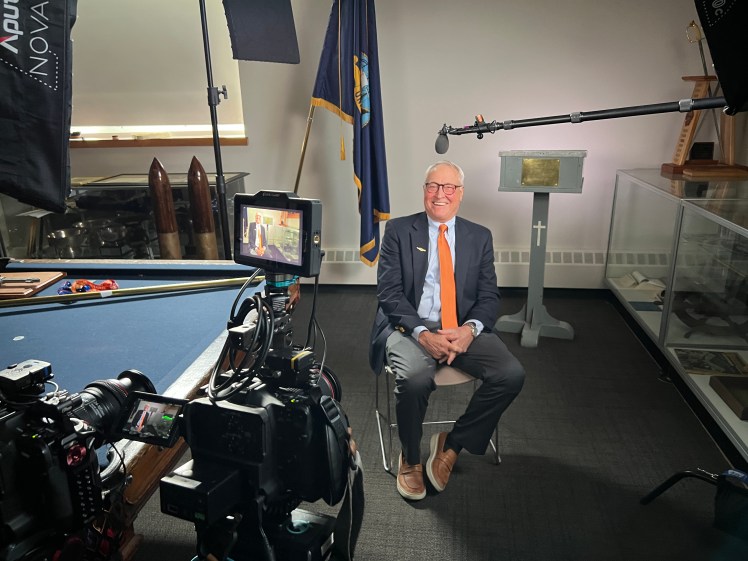
I was told this was the podium Father O’Callahan used when he celebrated Mass aboard the Franklin. I wanted it included in the shot when we interviewed Peter, and you can see it standing over his left shoulder in the photo above. My thanks to the young men who brought it down for us.
Peter talked about Father O’Callahan’s sacrifice—how he put himself in harm’s way, endured the death and destruction of war, and devoted himself to helping others who experienced it. That spirit of service inspired Peter in his own life, and he viewed his work with the O’Callahan Society as a way to give back.
Peter also noted that the O’Callahan Society sponsors three awards on campus, including one named after Father Joe, the Father Joseph T. O’Callahan Memorial Bowl, which is presented annually to an outstanding midshipman in the NROTC battalion. He added that the midshipmen understand Father O’Callahan’s significance to the campus and to the Society, and they know his place in the story of the USS Franklin.
All of this ensures that Father O’Callahan’s example continues to guide new generations and preserves his legacy of courage, dedication, and service.

Acknowledgements
Two years in the making, our filming at the College of the Holy Cross required substantial planning and preparation that was made possible only through the generous contributions of time, effort, and support from many individuals I wish to acknowledge.
I first began planning in 2023 after researching the Father Joseph O’Callahan archive at the college. My contact at the time was Abby Stambach, Head of Archives and Distinctive Collections. When I asked her about the history of the O’Callahan Society, she connected me with Tom Cadigan, Director of Alumni Regional and Special Programs in the Office of Advancement. Tom then introduced me to Alexandra Greeley, Associate Director of Alumni Engagement, who worked closely with the Society.
Alex patiently fielded a long list of my questions about the Society’s history and mission and put me in touch with Jim Delehaunty, who was then the immediate past Chair and a member of the Executive Committee. He brought Peter, the new Chair, into the conversation, along with Father Bob Keane and Brendan O’Donnell, also members of the Executive Committee. They generously shared emails, documents, and photographs, and we had a terrific Zoom call in the fall of 2023. I remain grateful to all of them for their time and support.
As the documentary progressed, I became absorbed in other aspects of the project and a demanding filming schedule throughout 2024 and 2025. Unfortunately, I let my connections with these generous individuals lapse, and I regret that oversight. When I reached out again in early fall of 2025 to finally plan filming on campus, Peter offered to assist and recommended that I contact John Hill, Chief Communications Officer in Media Relations. John then connected me with Nicoleta Jordan, Director of Public Relations.
It was Nicoleta who did the yeoman’s work that made everything else possible. She contacted departments across campus to identify staff willing to participate in the filming; she coordinated schedules to secure a date that aligned with the film crew’s availability; she introduced me to Lisa, Sarah, and Laura; and she even arranged parking for us through Public Safety. She also connected me with Matheau Taher, Purchasing and Contract Manager in the Office of Finance, who facilitated the execution of the Location and License Agreement that allowed us to film on campus.
In late October, Lisa, Sarah, Laura, Peter, and I met over Zoom to discuss timing, logistics, and the content of the interviews, as well as appropriate filming locations across campus. After agreeing on a schedule, Lisa secured permission from Father Garavel to film in the cemetery and from Captain Pinckney to film in the NROTC spaces. Laura and her staff arranged our access to the O’Callahan Science Library for the first half hour of its opening. (We ran a bit overtime, and a crowd of students waited patiently outside; I regretted cutting into their access to the library.)
Captain Pinckney stopped by the cemetery while we were filming to ensure we had what we needed for the following day’s interview. After filming in the cemetery, the film crew and I went to the NROTC offices to review the space previously discussed. Cynthia Hayes, Academic Administrative Assistant in Naval Science, let us into the building and she helped us look at adjacent spaces when we realized that the original suggested area would not be ideal. She communicated on our behalf to Captain Pinckney and Captain Marling who made last-minute arrangements for us to film in the O’Callahan wardroom instead. On the day of filming, Cynthia also helped us access the Wardroom and set up other logistics. The midshipmen using the wardroom when we arrived already knew that the space was reserved and kindly made way. Two more brought down the Franklin chaplain’s podium while we were setting up.
As you can see, even a single day of filming — along with the two hours we spent in the cemetery — drew upon the time, goodwill, and dedication of a remarkable number of people from both the college and the Society. To all of them, I extend my deepest gratitude. I am committed to creating a documentary worthy of the trust they placed in me and this project.
And as we draw closer to the end of production, my commitment extends to every single person who has contributed to this film.